JPG · JPEG · PNG · WEBP ·etc
Check Image DPI Online
An image DPI checker is a digital tool that identifies the dots per inch (DPI) or pixels per inch (PPI) value of an image file. This measurement tells you how many dots of ink or pixels appear in one linear inch of a printed or digital image. Photographers, designers, and anyone preparing images for print or web use rely on DPI checkers to ensure their images meet quality standards for their intended purpose.
What Is an Image DPI Checker?
An image DPI checker is software or an online tool that reads the metadata embedded in image files. This metadata contains technical information about the image, including its resolution measured in DPI or PPI.
DPI stands for dots per inch. It refers to the number of individual dots a printer can produce in a one-inch line. PPI means pixels per inch and describes how many pixels fit into one inch of a digital image. While technically different, these terms are often used interchangeably when discussing image resolution.
Image files store DPI information in their EXIF data or file headers. When you upload an image to a DPI checker, the tool reads this embedded information and displays it on your screen. Most checkers show both the DPI value and the image’s physical dimensions in pixels.
Common file formats that store DPI information include JPEG, PNG, TIFF, and PDF. Not all image formats contain this data. Some web-optimized images may not have DPI values embedded because web browsers display images based on pixel dimensions, not print resolution.
How Does an Image DPI Checker Work?
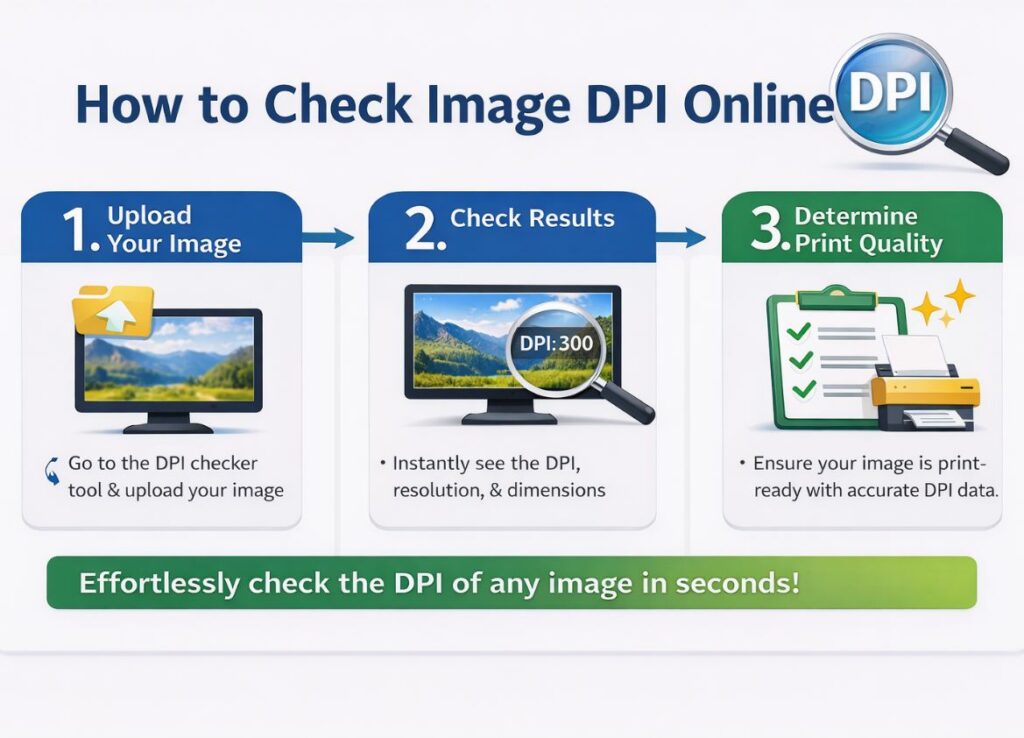
An image DPI checker operates through a simple technical process that extracts resolution data from your image file.
Step 1: File Upload You select an image file from your computer or drag it into the checker tool. The tool accepts common formats like JPEG, PNG, or TIFF files.
Step 2: Metadata Reading The checker scans the file’s header or EXIF data section. This hidden information contains technical specifications including the DPI setting, creation date, camera model, and other details.
Step 3: Data Extraction The tool identifies the horizontal and vertical resolution values. These values are typically stored as whole numbers, such as 72, 150, 300, or 600.
Step 4: Results Display The checker shows you the DPI value along with the image’s pixel dimensions. Some advanced checkers also calculate what physical print size the image can produce at different DPI settings.
Step 5: Additional Analysis Many tools provide extra information like file size, color space, and whether the image resolution is suitable for print or web use.
The entire process happens in seconds. Online DPI checkers process the file in your web browser without uploading your image to external servers, protecting your privacy. Desktop applications and photo editing software like Adobe Photoshop also include built-in DPI checking features.
Why Is Image DPI Important?
Understanding image DPI matters for anyone who works with digital images, especially when preparing files for specific uses.
Print Quality Standards Professional printing requires specific DPI values. Magazines, books, and marketing materials typically need 300 DPI for sharp, clear images. Lower DPI values produce blurry or pixelated prints. A photo that looks perfect on your computer screen may print poorly if its DPI is too low.
File Size Management Higher DPI creates larger file sizes. A 300 DPI image contains much more data than the same image at 72 DPI. Checking DPI helps you balance quality and file size based on your needs.
Web vs. Print Requirements Websites display images at 72 to 96 DPI because computer screens have lower pixel density than printed materials. Using 300 DPI images on websites wastes bandwidth and slows page loading without improving visual quality. An image DPI checker helps you optimize files for their destination.
Professional Standards Compliance Print shops, publishers, and design agencies have strict DPI requirements. A book publisher might reject manuscript images below 300 DPI. Checking DPI before submission prevents costly delays and rejections.
Cost Efficiency Commercial printing costs often relate to image quality and file size. Knowing your image DPI helps you avoid paying for unnecessarily high resolution or suffering from poor print quality due to insufficient resolution.
According to printing industry standards established by organizations like the Printing Industries of America, 300 DPI remains the benchmark for professional offset printing as of 2024. Large format printing for billboards and posters can use lower DPI (around 150 DPI) because viewers see these images from greater distances.
Real-World Applications of Image DPI Checkers
Image DPI checkers serve practical purposes across multiple industries and everyday situations.
Photography and Portfolio Preparation Professional photographers check DPI before sending images to clients or galleries. Wedding photographers ensure their album prints meet the 300 DPI standard. Stock photography websites require specific DPI values, and photographers use checkers to verify their uploads meet marketplace requirements.
Publishing Industry Book publishers, newspaper editors, and magazine designers check every image DPI before layout. A cookbook with food photos, a textbook with diagrams, or a news article with photographs all require proper DPI verification. The New York Times and similar publications maintain strict image resolution guidelines that require DPI checking.
Marketing and Advertising Companies creating brochures, business cards, or billboard advertisements use DPI checkers during the design process. A real estate agent printing property flyers needs 300 DPI images. A company designing a trade show banner checks whether their logo file has sufficient resolution.
E-commerce Product Images Online retailers optimize product photos for web viewing. They check DPI to ensure images load quickly while maintaining visual appeal. Amazon recommends images at 72 DPI with specific pixel dimensions for optimal display.
Academic and Scientific Publishing Research journals require figures, graphs, and photographs to meet specific DPI standards. A scientist submitting a paper to Nature or Science must verify that microscope images, charts, and illustrations meet the journal’s 300 to 600 DPI requirements for print publication.
Personal Projects Individuals creating photo books, greeting cards, or custom gifts use DPI checkers to ensure their personal images print clearly. Someone designing wedding invitations or printing vacation photos wants to avoid disappointment from blurry results.
Common Questions and Misconceptions About Image DPI
Misconception: Higher DPI Always Means Better Quality Truth: DPI only matters in relation to the image’s intended use and physical size. A 72 DPI image is perfect for a website. Increasing DPI in software without adding actual pixel data does not improve quality—it only changes a number in the file’s metadata.
Misconception: You Can Fix Low DPI by Changing the Setting Truth: Simply changing a 72 DPI image to 300 DPI in software does not add detail. The image contains the same number of pixels. True resolution improvement requires either starting with a higher-quality original or using specialized AI upscaling tools that add interpolated data.
Misconception: All Images Need 300 DPI Truth: Digital screens display images effectively at 72 to 96 DPI. Social media posts, website photos, and digital presentations do not benefit from 300 DPI. Using unnecessarily high DPI for web images wastes storage space and slows loading times.
Misconception: DPI and Resolution Are the Same Truth: DPI describes print density, while resolution refers to total pixel dimensions. A 3000 x 2000 pixel image has high resolution regardless of its DPI setting. The same pixel dimensions at different DPI values create different physical print sizes.
Question: Why Do My Phone Photos Sometimes Show No DPI? Answer: Many smartphones save photos without embedded DPI metadata or default to 72 DPI. The actual image quality depends on pixel dimensions, not the DPI number. A modern smartphone photo with 4000 x 3000 pixels prints beautifully even if it shows 72 DPI.
Question: Can I Print a 72 DPI Image? Answer: Yes, but the print size will be limited. A 1440 x 1080 pixel image at 72 DPI prints at 20 x 15 inches. The same image at 300 DPI prints at approximately 4.8 x 3.6 inches. Printing the 72 DPI version at the smaller size produces the same quality as the 300 DPI version.
DPI in the Context of Modern Technology
Screen technology has evolved significantly since DPI standards were established. Modern smartphones and tablets use “Retina” displays and other high-pixel-density screens.
Apple’s Retina displays, introduced in 2010, pack 326 pixels per inch into iPhone screens. Desktop monitors typically show 96 to 110 PPI. This explains why images appear differently on various devices even though they have identical DPI settings.
The printing industry continues using 300 DPI as the standard because human eyes can distinguish individual dots when print resolution drops below this threshold at normal viewing distances. Research in vision science shows that human visual acuity peaks at approximately 300 to 400 pixels per inch at reading distance.
4K and 8K displays have changed how we view digital images. These ultra-high-resolution screens benefit from images with higher pixel counts, though DPI remains less relevant for screen viewing than total pixel dimensions.
Choosing and Using an Image DPI Checker Tool
Dozens of free and paid DPI checker tools exist online and as downloadable software.
Online Web Tools Websites like DPI Analyzer, PPI Calculator, and various free image tools let you upload files for instant DPI checking. These tools work in your browser without requiring software installation. They typically process files client-side, meaning your images do not upload to external servers.
Professional Software Adobe Photoshop, GIMP, and other image editors display DPI information in the image properties or document settings. These programs also let you change DPI values and see how adjustments affect potential print sizes.
Operating System Tools Windows File Explorer shows DPI in the file properties details tab. Mac users can view image DPI in Preview by opening Image > Adjust Size and looking at the resolution field.
Mobile Apps Smartphone apps like Photo Investigator (iOS) and Photo Exif Editor (Android) check DPI and other metadata on mobile devices.
When selecting a tool, consider whether you need basic DPI information or advanced features like batch processing, DPI conversion, or detailed EXIF data analysis.
FAQ About Image DPI Checker
What DPI should my image be for printing?
Use 300 DPI for most professional printing including photos, magazines, and marketing materials. Large format prints like posters can use 150 DPI because viewers see them from farther away.
Can I check DPI on my phone?
Yes, mobile apps like Photo Investigator or Exif Viewer display image DPI and other metadata directly on your smartphone. Some phones show this information in the native gallery app’s file details.
Does changing DPI affect image quality?
Changing the DPI number in file metadata without changing pixel dimensions does not affect the actual image data. The quality remains identical, but the potential print size changes.
Why do my screenshots show 72 DPI?
Operating systems capture screenshots at screen resolution, typically 72 to 96 DPI. This matches display technology and creates appropriately sized files for digital use.
What is the difference between DPI and PPI?
DPI measures printer output dots, while PPI measures digital image pixels. For practical purposes when checking images, these terms describe the same concept how much detail fits into one inch.
Conclusion
An image DPI checker provides essential information about image resolution and print capabilities. These tools help photographers, designers, and everyday users ensure their images meet quality requirements for specific purposes. Understanding that 300 DPI suits printing while 72 DPI works for digital screens allows you to optimize images appropriately. Whether you use online tools, professional software, or built-in system features, checking DPI takes seconds and prevents quality problems in final printed or displayed images.